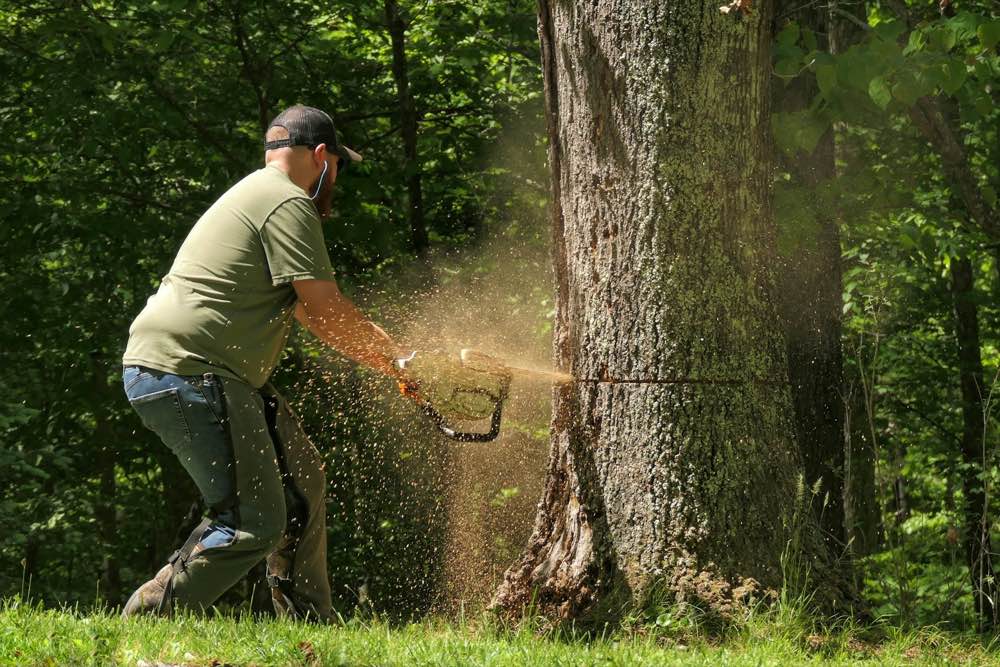
What tree cutting and removal involves
Tree cutting and removal is taking a whole tree down to a stump and clearing it out of the way. In an open field that can mean one cut and a controlled fall. In most Macon yards it doesn't. Trees here tend to sit close to houses, fences, sheds, driveways, and service lines, so a crew usually climbs or uses a bucket truck and takes the tree apart from the top down, lowering pieces with ropes.
A typical removal includes cutting the tree, lowering or dropping the sections, cutting the trunk into rounds, chipping the branches, and leaving a stump a few inches above the ground. Stump grinding and hauling away the trunk wood are often separate line items, so ask what's included.
When removal makes sense
Trimming saves a lot of trees. Removal is usually the right call when:
- The tree is dead, or more than about half of the crown is dead.
- The trunk has a large cavity, deep cracks, or fungus growing from the base.
- It's leaning toward a structure and the lean is new or getting worse.
- Roots are lifting a foundation, slab, or driveway, or have been badly cut.
- It's simply in the wrong spot: too close to the house or crowding out other trees.
A tree pro can tell you whether a tree is worth saving. If one recommends removal for a healthy tree, it's fair to ask why and to get a second opinion.
Warning signs to look for
Walk around the tree and look up. Call for an estimate if you notice:
- Bare branches in summer, or a pine whose needles turned brown or red.
- Bark falling off in sheets, or small holes and sawdust in the bark.
- Mushrooms or conks at the base or on the trunk.
- Soil cracking or heaving on one side of the tree.
- A split where two big trunks meet in a V.
How a removal job usually goes
- Estimate. The pro looks at the tree, what's under it, and how equipment can get in. Many can quote from clear photos, but large or tricky trees usually need a visit.
- Scheduling. Routine removals are booked ahead. Storm season can push wait times out.
- Set-up. The crew sets up a work zone, moves cars, and protects what's under the tree.
- Takedown. Limbs come off first, then the trunk in sections. Rigging lowers pieces that can't be dropped.
- Cleanup. Brush is chipped, wood is cut into rounds or hauled, and the yard is raked.
What affects the price
Every tree is different, so take any price you see online as a rough range. The main factors are height and trunk diameter, how close the tree is to the house or lines, whether a climber, bucket truck, or crane is needed, access for equipment, the tree's condition (dead wood is less predictable to rig), and how much cleanup and stump work you want. Our tree removal cost guide covers typical ranges.
Safety notes
Felling a tree near a building is one of the more dangerous jobs a homeowner can try. Trees rarely fall exactly where planned, and a dead tree can break unpredictably. Leave anything near a structure or power line to a professional. Before work starts, ask the pro for proof of liability insurance and, if they have employees, workers' compensation coverage.
Rules on removing trees vary. Check with Macon-Bibb County before removing large trees, especially in historic districts, and check with your HOA if you have one.
Frequently asked questions
How long does it take to remove a tree?
A small or medium tree in an open spot can be done in a few hours. A large tree near a house that has to be taken down piece by piece can take most of a day, sometimes longer.
Is the stump removed too?
Not always. Many quotes leave the stump a few inches above ground. Ask for stump grinding to be included if you want it gone.
Can I keep the firewood?
Usually, yes. Tell the pro up front. Leaving the wood in rounds can lower the price because there's less to haul.
Will removing a tree damage my lawn?
Equipment and falling wood can leave ruts and dents, especially on wet clay. Ask the crew how they protect the lawn and driveway.