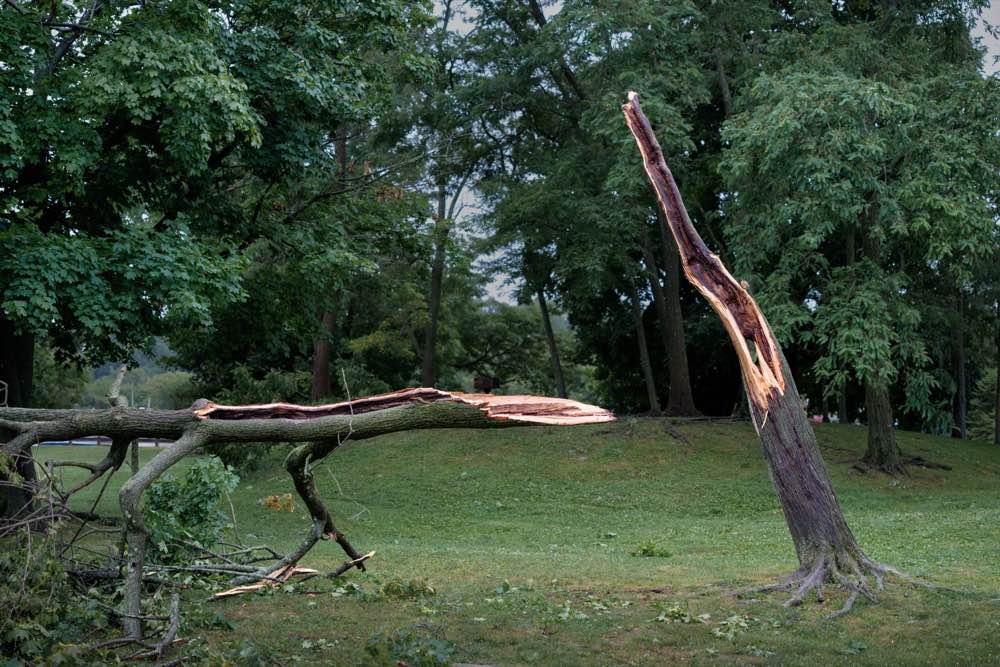
Storms and trees in Middle Georgia
Middle Georgia gets its share of rough weather. Spring brings lines of strong thunderstorms, summer afternoons bring pop-up storms with gusty winds and lightning, and in some years the remnants of tropical systems push heavy rain and wind inland. Any of these can drop trees, and the common pattern in Macon is the same: soil gets soaked, then wind hits tall pines and big oaks that can't hold.
Storm cleanup is the work of making the property safe again and getting the wood off the ground.
What storm cleanup includes
- Removing trees that have fallen across yards, fences, driveways, or structures.
- Taking down snapped trunks and trees left leaning or uprooted.
- Cutting out "hangers": broken limbs stuck in the canopy that can fall later.
- Trimming torn branch stubs so the tree can seal over cleanly.
- Chipping brush and hauling off logs and debris.
- Grinding stumps of trees that came down, if you want.
What to check after a storm
Once the weather has passed and it's safe to go outside, walk the property and look for:
- Limbs hanging in the canopy, especially over the roof, driveway, or play areas.
- Trees that are newly leaning, or with soil lifted or cracked around the base.
- Split trunks or cracks where two trunks join.
- Bark torn off in long strips, which can mean a lightning strike.
- Trees resting on other trees.
Look from a distance and don't stand under damaged trees. Pines hit by lightning sometimes look fine for a few weeks and then die; a pro can tell you whether one is worth watching or should come down. Storm-injured pines are also prime targets for Ips bark beetles; the Georgia Forestry Commission's handout on Ips beetles and storm damage explains what to watch for.
How the cleanup usually goes
Crews work from most dangerous to least. Trees on structures and blocked driveways come first. Then hangers and leaning trees, then the wood on the ground. After big storms, tree services triage calls the same way, so a tree lying in the back yard may wait longer than one on a roof.
For large cleanups, ask whether the crew hauls everything or leaves logs cut to length for you to deal with. Leaving wood can lower the cost.
What affects the price
The number of trees, their size, whether anything is resting on a structure, whether wood is under tension, how far equipment can get to the work, and how much you want hauled away. Storm work often costs more than a scheduled job because demand spikes and the work is riskier. See the cost guide for typical ranges.
Safety notes
- Treat every downed wire as live. Stay well back and call the utility. Georgia Power's power line safety guidance is blunt: never try to pull branches off a line.
- Don't run a chainsaw on trees or limbs that are bent or pinned. Stored tension can throw the saw or the wood.
- Watch for "widowmakers": broken limbs hanging overhead that can drop without warning.
- After a big storm, be wary of anyone going door to door asking for full payment up front. Get the name, phone number, and proof of insurance before anyone works.
Frequently asked questions
Does insurance cover storm cleanup?
Often for trees that hit a covered structure, usually up to a limit. Trees that fall without hitting anything may not be covered. Check your policy.
How soon can someone come?
After a widespread storm, every tree service is busy. Call (478) 309-7511 early, describe whether anything is damaged or blocked, and we'll try to connect you with a pro.
Should I remove a tree that survived but looks damaged?
Not necessarily. Many trees recover from losing limbs. Have a pro look at it; trimming may be enough.