What makes a tree hazardous
Arborists think about tree risk as two questions: how likely is the tree (or a part of it) to fail, and what will it hit if it does? A cracked oak in the middle of a pasture isn't much of a hazard. The same oak over a bedroom is.
In Macon, the trees people worry about most are tall pines near the house, big water oaks and laurel oaks with decay, and any tree that's started leaning after a storm.
Warning signs
Call for an estimate if you see any of these on a tree that could reach your house, driveway, or a neighbor's property:
- A new or worsening lean, especially with soil cracked or mounded on the opposite side.
- Cracks in the trunk or where large limbs or co-dominant trunks meet.
- Cavities or soft, punky wood in the trunk.
- Fungus growing on the trunk or at the root flare.
- Dead limbs larger than your arm, especially over the roof.
- Root damage from trenching, construction, or paving.
- A pine with a dead top or brown needles.
- Heavy limbs hanging far out over the roof.
Not every lean is bad. Trees that grew toward light at an angle can be stable for decades. A change in lean is what matters.
How hazardous removals are handled
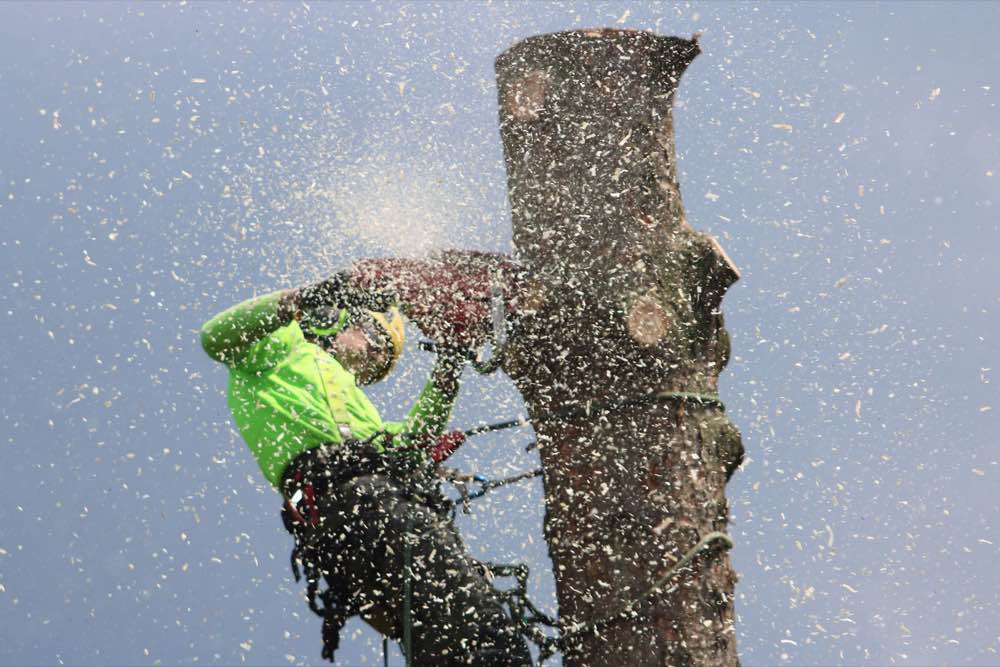
These jobs are about control. The crew can't let the tree, or pieces of it, fall where they want, so they:
- Climb, or use a bucket truck, and take the tree down in small sections.
- Rig pieces with ropes and lowering devices so nothing free-falls near the house.
- Use a crane when the tree is too weak to climb or too big to piece down safely.
- Set up a drop zone and keep people out of it.
Sometimes the pro will suggest a lighter fix: removing one problem limb, reducing weight on the leaning side, or installing cables and braces. Ask whether those options make sense for your tree.
What affects the price
Hazardous removals usually cost more than removing the same size tree in an open spot. Factors include proximity to the house, how much rigging is needed, whether the tree can be climbed safely, crane or bucket truck time, access, and cleanup. See the cost guide for typical ranges.
Safety notes
- If a tree has shifted suddenly or the root plate is lifting, keep everyone out of the area it could hit and call (478) 309-7511 right away.
- If it's touching or could hit a power line, call your electric utility first.
- Ask for proof of liability insurance before a crew starts a job near your home.
- Check with Macon-Bibb County before removing large trees, and with your HOA if you have one. Some places handle hazardous trees differently.
Frequently asked questions
Can someone tell me if my tree is actually dangerous?
Yes. A tree pro can look at it and give an opinion. For a formal written risk assessment, some arborists are trained in tree risk assessment; ask if that's offered.
What if the hazardous tree is on my neighbor's property?
Talk to your neighbor first. Rules on who's responsible vary. Your insurer can explain how coverage works if it falls on your house.
Is a leaning tree always hazardous?
No. A tree that has always leaned and has a solid root plate can be fine. A tree that started leaning recently is a different story.