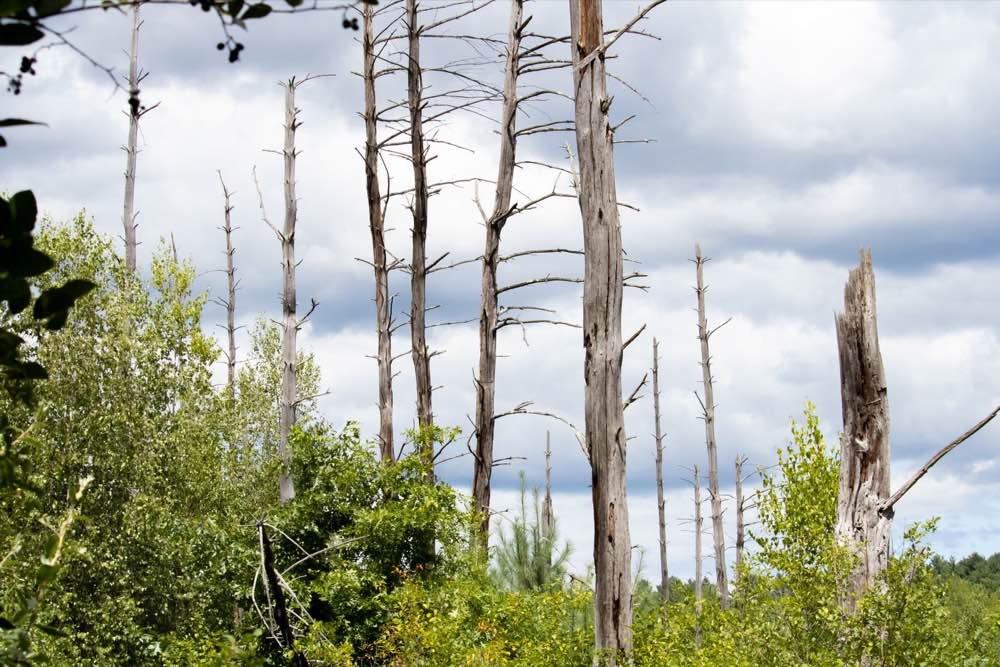
Why dead trees shouldn't wait
A dead tree doesn't fall right away, but it gets weaker every month. Wood dries out, decay spreads, and branches drop without warning. Dead pines can snap partway up the trunk; dead oaks tend to shed large limbs and then fail at the base as roots rot.
Dead trees are also more dangerous to take down the longer they stand. A climber can't safely tie into brittle wood, so badly decayed trees often need a bucket truck or crane, which costs more. Removing a tree soon after it dies is usually safer and cheaper.
How to tell if a tree is dead
- No leaves in season on a hardwood, or only a few small, pale leaves.
- Needles turning red or brown on a pine, often across the whole crown within weeks.
- Bark loosening and falling off in sheets.
- Small holes, pitch tubes, or fine sawdust on pine bark, signs of bark beetles.
- Mushrooms or shelf fungus on the trunk or roots.
- Brittle twigs. Scratch a twig with a fingernail: green underneath means it's alive; brown and dry means that part is dead.
A tree that's only partly dead can sometimes be saved by removing dead limbs. A pro can tell you which you have.
Common causes in Middle Georgia
Pines in Middle Georgia can die from bark beetles, especially after drought or lightning damage weakens them. Water oaks and laurel oaks, common yard trees here, are relatively short-lived and often develop internal decay as they age. Construction damage is another big one: trenching, grading, or parking on roots near a tree can kill it a few years later. Lightning strikes and storm wounds also let decay in.
If one pine dies from beetles, have nearby pines checked. Beetle problems can spread to neighboring trees.
How removal usually goes
The pro first judges how sound the wood is. If the tree is solid enough to climb, it's taken down in sections like any removal. If not, the crew works from a bucket truck, uses a crane, or drops it whole if there's open space. Dead wood is unpredictable, so expect the crew to take extra care with rigging and keep everyone well back.
What affects the price
Size, how close the tree is to structures, how far decay has gone (which determines whether climbing is safe), the equipment needed, access, and cleanup. A dead tree that's been standing for a few years can cost noticeably more to remove than it would have right after it died. See the cost guide.
Safety notes
Don't stand, park, or let kids play under a dead tree. Don't try to cut one down yourself. Dead trees can break at the cut, split up the trunk, or drop limbs from above when the trunk is struck. If it's near the house, treat it as a hazardous tree.
Some HOAs and local codes treat dead trees differently from live ones when it comes to removal permission. Check with Macon-Bibb County and your HOA if you're unsure.
Frequently asked questions
How long can a dead tree stand?
It varies a lot. Some stand for years, others fail within months, especially in storms. There's no safe way to predict it.
Is a dead tree my responsibility if it falls on a neighbor's property?
Liability rules can depend on whether the owner knew or should have known the tree was dead. If you know it's dead, deal with it. For legal questions, ask your insurer or an attorney.
Can a dead tree be used for firewood?
Often, yes, if it's not too rotten. Tell the pro you want the wood left in rounds.